
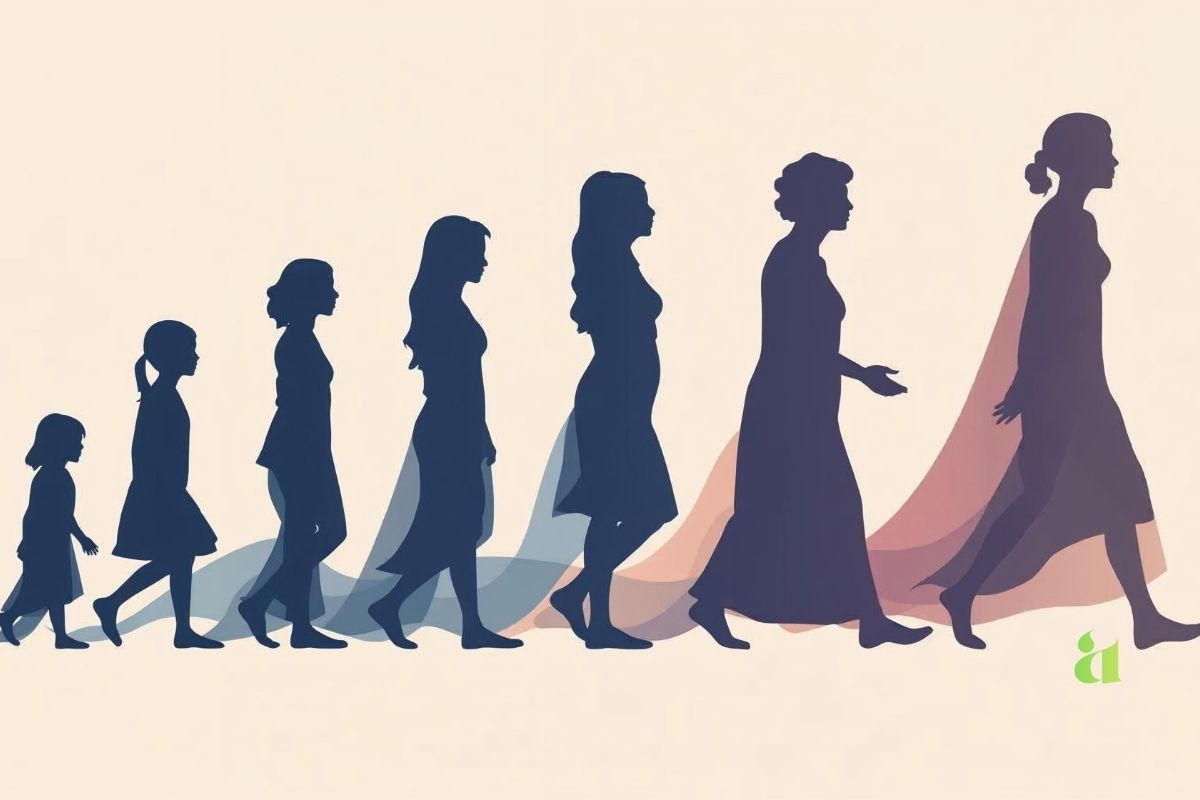
A Woman’s Journey Through Every Stage of Life: Identity, Growth and Self-Understanding
A woman’s journey through every stage of life is not a straight line. It is shaped by changing relationships, responsibilities, choices, losses, discoveries, expectations and moments of self-understanding.
Some stages may feel full of possibility. Others may feel uncertain or demanding. Some bring visible change, while others involve an internal shift that nobody else notices.
A woman does not simply move from one age to another. She continually develops a changing relationship with herself.
This journey is also deeply personal. Not every woman follows the same path, becomes a mother, marries, builds a career, or experiences the same responsibilities. What connects many life journeys is not a particular sequence of events, but the ongoing process of understanding who we are as circumstances change.
1. A Woman’s Journey Through Every Stage of Life Begins With Identity
Early life is often a time of curiosity and discovery.
A girl begins learning about herself through family, friendships, school, culture, surroundings and everyday experiences. She gradually develops ideas about what she likes, what she fears, what she values and how she wants to be seen.
Some of these ideas come from within.
Others come from the people around her.
Over time, these influences become part of her developing identity.
But identity is not something that has to be permanently decided in childhood.
People change.
Their priorities change.
Their understanding of themselves changes.
A woman who once believed she wanted one kind of life may discover something completely different years later.
That does not necessarily mean she was confused before.
It may simply mean she grew.
2. Growth Brings Greater Emotional Awareness
As life progresses, a woman may become more aware of her emotional patterns, needs and boundaries.
She may begin noticing questions that were previously difficult to articulate:
- Why does this situation affect me so strongly?
- What am I actually feeling?
- What do I need right now?
- Which relationships give me energy?
- Which expectations no longer fit the person I am becoming?
- What am I doing because I genuinely want to do it?
This kind of reflection can create inner awareness—the ability to observe our thoughts, emotions and reactions with greater honesty.
It does not mean understanding ourselves perfectly.
It means becoming more willing to notice what is happening inside us.
3. Responsibility Can Reshape the Way a Woman Sees Life
Career, relationships, family responsibilities, financial decisions and personal commitments can change the way a woman understands herself.
Sometimes responsibility brings confidence.
Sometimes it brings pressure.
Often, it brings both.
A woman may find herself balancing her own needs with the needs of other people.
She may become a daughter supporting parents, a partner building a relationship, a mother caring for children, a professional managing responsibilities, or simply an individual trying to create a meaningful life.
But these roles should not become the entire definition of her identity.
A woman can care deeply for others and still have interests, ambitions, friendships, boundaries and dreams that belong to her alone.
The challenge is not to choose between responsibility and individuality.
It is to find a way for both to exist.
4. Difficult Experiences Can Change Her Understanding of Strength
Not every stage of life is comfortable.
There may be disappointment, financial pressure, relationship changes, grief, career setbacks, health concerns, loneliness or uncertainty.
Difficult experiences can alter the way a person sees the world.
But it is important not to romanticize hardship.
Pain does not automatically make someone wiser.
Sometimes difficult experiences simply hurt.
Growth may come later, when a person has enough distance to understand what happened, what she needs, what she wants to change and what she no longer wants to carry.
These experiences can eventually become part of our broader life reflections, influencing future decisions and our understanding of ourselves.
Strength, therefore, is not always about becoming tougher.
Sometimes strength means becoming more honest about what hurts.
5. Self-Understanding Deepens With Time
As a woman moves through different experiences, her priorities may change.
Things that once seemed extremely important may become less significant.
External approval may lose some of its power.
Certain relationships may become more meaningful, while others may naturally become distant.
She may begin asking:
Does this actually matter to me?
Am I living according to my values?
What kind of life feels meaningful now?
This shift can move a person toward greater authenticity.
Authenticity does not mean saying everything you think or rejecting every expectation.
It means developing a clearer understanding of what matters to you and making choices that are reasonably consistent with that understanding.
6. Emotional Independence Does Not Mean Isolation
Emotional independence is sometimes misunderstood.
It does not mean never needing anyone.
It does not mean avoiding relationships.
It does not mean becoming emotionally distant.
It can simply mean developing enough inner stability to recognize that your entire sense of worth does not have to depend on another person’s approval.
A woman can love deeply and still maintain her individuality.
She can ask for help without considering herself weak.
She can receive support while continuing to make her own decisions.
Healthy independence and healthy connection do not have to be opposites.
Maintaining your identity while building meaningful relationships can also deepen your understanding of self-love and self-respect.
7. Reflection Helps Turn Experience Into Understanding
With time, experiences begin to connect.
A difficult period may make more sense years later.
A relationship may teach something that becomes useful in another part of life.
A mistake may reveal a pattern that was previously invisible.
Reflection allows these experiences to become part of a larger personal story.
This is why growth is rarely as simple as moving from one stage to another.
We often revisit old questions from a different perspective.
Something that confused us at twenty may look completely different at forty.
Something that felt like failure at thirty may later become the experience that redirected our life.
Growth can therefore be understood as integration—not forgetting the past, but understanding it differently.
When a Woman Begins to Understand Herself
There can be a quiet stage in a woman’s journey when she starts seeing herself less through expectations and more through awareness.
As a child, she absorbs the world.
As a young girl, she learns how to adapt to it.
As a young woman, she may try to build a place within it.
And somewhere along the way, she may begin asking different questions:
Who am I beneath the roles?
Not only daughter.
Not only partner.
Not only mother.
Not only professional.
Not only achiever.
Just herself.
This shift does not always happen dramatically.
Sometimes it begins with a quiet realization.
Sometimes it follows disappointment.
Sometimes it appears after years of putting everyone else first.
And sometimes it simply comes with age and reflection.
The important part is that she begins to understand that her identity does not have to be permanently defined by other people’s expectations.
The Quiet Strength That Can Develop in Midlife
Midlife is sometimes described only through the language of ageing or decline.
But that is an unnecessarily narrow way to understand it.
For many people, midlife can also be a period of reassessment.
A woman may have experienced relationships that stayed and relationships that ended.
She may have changed careers, raised children, supported family members, developed new interests or let go of old ambitions.
She may have learned that not every opportunity needs to be pursued.
Not every disagreement needs to be won.
Not every relationship needs to be maintained.
Not every expectation deserves her energy.
With experience, she may become more comfortable saying:
This matters to me.
And also:
This no longer matters to me.
That clarity can be a quiet form of strength.
Wisdom Does Not Always Look Dramatic
Wisdom is often imagined as having all the answers.
Real life rarely works that way.
A wiser person may simply become more comfortable with uncertainty.
She may listen before reacting.
She may recognize that two people can experience the same situation differently.
She may understand that boundaries do not necessarily mean rejection.
She may accept that some relationships change without either person being entirely at fault.
She may become less interested in proving herself and more interested in living according to what she values.
Wisdom can therefore look very ordinary.
It can be choosing not to respond immediately.
It can be apologizing when necessary.
It can be leaving an unhealthy situation.
It can be asking for help.
It can be starting again.
Emotional Evolution Is Not a Straight Line
A woman’s journey through every stage of life is not a staircase.
It is closer to a spiral.
Old emotions may return.
Old fears may resurface.
A previous version of yourself may appear again in an entirely new situation.
You may become a parent and suddenly understand something about your own childhood.
You may change careers and rediscover an interest you had forgotten.
You may enter a new relationship and realize that an old emotional pattern still needs attention.
Growth does not mean never returning to the same questions.
It can mean meeting those questions with a different level of awareness.
The Unseen Work of Becoming
Much of a woman’s growth happens without an audience.
The self-doubt she works through privately.
The boundaries she learns to communicate.
The difficult conversation she finally has.
The fear she chooses not to let make every decision.
The expectations she slowly releases.
The parts of herself she learns to accept.
None of these moments may appear impressive from the outside.
Yet they can change the direction of a life.
The world often measures achievement through visible outcomes.
Personal growth is not always visible.
Sometimes the most important change is simply becoming more comfortable being yourself.
The Role of Self-Compassion
Many women carry invisible emotional weight.
They may feel responsible for remaining strong for everyone else.
They may judge themselves harshly when they cannot meet every expectation.
They may ask:
“Why am I struggling?”
A gentler question can sometimes be:
“What do I need right now?”
Self-compassion does not mean avoiding responsibility.
It means allowing yourself to respond to difficulty without automatically turning it into self-criticism.
There may be days when you are productive and days when you are tired.
There may be moments when you make excellent decisions and moments when you learn from mistakes.
A meaningful relationship with yourself has room for both.
When Life Does Not Follow the Expected Timeline
One of the most difficult parts of adulthood can be comparing your life with an imagined timeline.
You may see someone getting married earlier.
Someone else may have children.
Another person may build a successful career.
Someone may travel extensively.
Someone else may choose a quieter life.
These differences do not automatically mean that one person is ahead and another is behind.
Life circumstances vary.
Opportunities vary.
Responsibilities vary.
Values vary.
A meaningful life cannot always be measured against someone else’s calendar.
Sometimes growth means learning to distinguish between the life you genuinely want and the life you have been taught to want.
Later Years Can Bring a Different Kind of Clarity
Later stages of life are often portrayed only as a period of slowing down.
But slowing down does not necessarily mean becoming less.
It can mean having fewer reasons to perform for others.
A woman may carry years of experiences—mistakes, relationships, work, family memories, disappointments, achievements, reinvention and ordinary moments.
She may understand that strength is not always visible.
Sometimes strength is staying present.
Sometimes it is accepting what cannot be changed.
Sometimes it is continuing to care without losing yourself.
With experience, intensity may become less important than steadiness.
And certainty may become less important than peace.
A Woman’s Journey Can Include Reinvention
There is no rule that says a woman has to remain the same person simply because other people have become accustomed to her identity.
She may discover a new interest at forty.
Change careers at fifty.
Begin studying something new later in life.
Develop new friendships.
Travel alone.
Return to creative work.
Choose a simpler lifestyle.
Or decide that she wants to spend more time doing things that were always meaningful to her.
Reinvention does not erase the earlier versions of herself.
It adds another layer.
A Simple Reflection Exercise
Take a quiet moment and consider these questions:
- What part of my identity has changed the most over the years?
- Which expectations do I still carry even though they no longer fit me?
- What experiences have taught me something important about myself?
- Where in my life do I need stronger boundaries?
- What currently gives me a sense of meaning?
- What am I continuing only because I am afraid of disappointing someone?
- What part of myself would I like to understand better?
- What do I want the next stage of my life to feel like—not just look like?
There is no perfect answer to these questions.
Their purpose is simply to create space for honest reflection.
A Woman’s Journey Through Every Stage of Life Is Personal
There is no universal version of womanhood.
Some women marry.
Some do not.
Some become mothers.
Some do not.
Some build careers.
Some prioritize family.
Some change direction many times.
Some remain in one profession for decades.
Some discover themselves through relationships.
Others discover themselves through solitude, work, creativity, travel, learning or unexpected life changes.
A meaningful discussion about a woman’s journey should leave room for these differences.
The goal is not to create another standard that women feel pressured to meet.
It is to recognize that every woman has the right to understand her own life in her own way.
A Woman’s Journey Through Every Stage of Life and Conscious Living
As self-understanding develops, everyday choices can become more intentional.
Instead of automatically following old habits, a woman may begin asking why she is making a particular choice.
Why am I saying yes?
Why am I staying?
Why am I afraid to change?
What am I prioritizing?
What do I actually value?
This kind of attention connects naturally with conscious living—the practice of bringing greater awareness to everyday choices rather than moving entirely through habit or external expectation.
It does not require a perfect lifestyle.
It begins with noticing.
Growth Does Not Mean Becoming Someone Else
Perhaps one of the most important lessons in a woman’s journey through every stage of life is that growth does not require becoming someone completely different.
You can become more aware without becoming less yourself.
You can become stronger without becoming harder.
You can become independent without becoming isolated.
You can become successful without allowing achievement to define your entire identity.
You can care for others without disappearing inside their needs.
And you can change your mind without considering your earlier self a failure.
Growth is not always about adding more.
Sometimes it is about removing what no longer belongs.
FAQ: A Woman’s Journey Through Every Stage of Life
What does a woman’s journey through every stage of life mean?
It refers to the changing experiences, identities, responsibilities, relationships and forms of self-understanding that can occur throughout a woman’s life. The journey is personal and does not follow one universal timeline.
Is every woman expected to experience the same life stages?
No. Women have different circumstances, cultures, priorities and choices. Marriage, motherhood, career and other milestones are not universal requirements for a meaningful life.
Why does identity change throughout life?
Identity can develop as people experience new relationships, responsibilities, challenges, interests and perspectives. What feels important at one stage of life may change as circumstances and understanding change.
Does emotional independence mean not needing other people?
No. Emotional independence does not mean isolation. It can mean maintaining a sense of self and personal stability while still accepting support and building meaningful relationships.
Why is self-compassion important?
Self-compassion can provide a more constructive way of responding to mistakes, difficult emotions and periods of uncertainty instead of automatically turning them into harsh self-judgment.
Can a woman reinvent herself later in life?
Yes. People can learn new skills, develop new interests, change priorities and make meaningful changes at many stages of life.
What is the most important part of personal growth?
There is no single answer. For many people, growth involves becoming more aware of their values, understanding their patterns, accepting change and making choices that are more consistent with who they want to become.
Final Reflection
A woman’s journey through every stage of life is not about becoming perfect.
It is about becoming more aware.
There may be seasons of confidence and seasons of uncertainty.
There may be relationships that stay and relationships that change.
There may be dreams that come true and dreams that quietly evolve into something else.
Through all of it, there remains an opportunity to understand yourself a little more deeply.
A woman does not have to become someone else to be worthy.
She can grow, change, pause, begin again and still remain connected to the person she has always been.
Perhaps the journey is not about reaching a final version of yourself.
Perhaps it is about continuing to meet yourself honestly as life changes.
If this stayed with you, you can support Aarohi here🌿
If this piece stayed with you, you can support Aarohi 🌿
Secure payments via UPI, Cards, Net Banking & PayPal
This is not a transaction, it is an exchange of energy.